
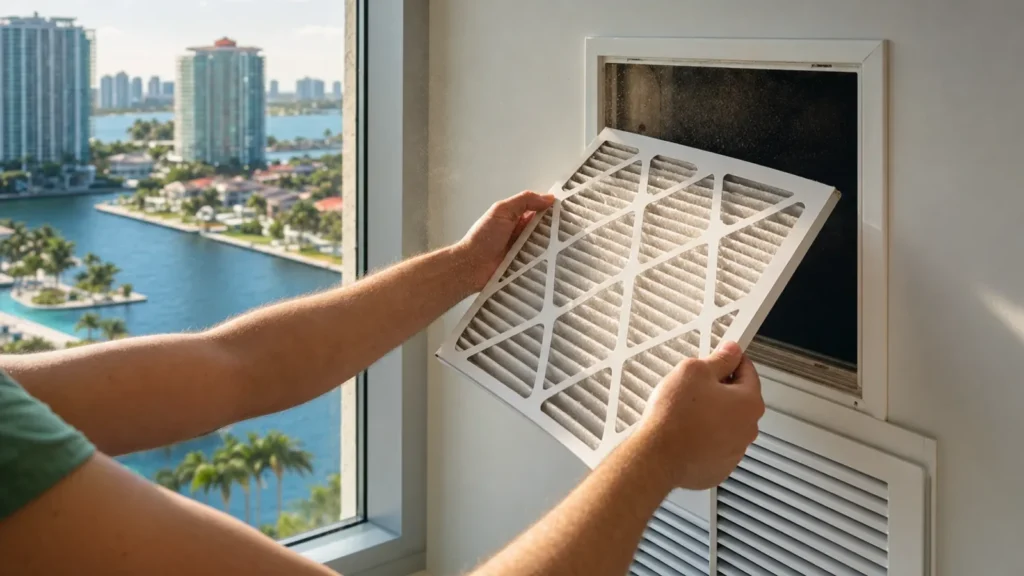
How to Maintain Your HVAC System After a Deep Cleaning in Aventura
That first breath of noticeably fresher air after a deep duct cleaning is satisfying, but here in Aventura, Florida, the subtropical climate starts working against your system almost immediately. Salt air drifts in from the Intracoastal, humidity rarely lets up, and AC units run nearly year-round. Knowing how to maintain AC vents after cleaning is what separates a one-time fix from lasting results.
Use this checklist as your go-to reference. Each section covers a specific maintenance area, and every item is written as a concrete action you can take at home or schedule with a pro. For a full picture of what a professional service involves from start to finish, see our complete guide to professional air duct cleaning in Aventura.
1. Air Filter Maintenance Checklist
Your filter is the first line of defense between the outside world and your freshly cleaned ductwork. In Aventura’s high-humidity, high-pollen environment, filters load up faster than manufacturers’ general guidelines suggest.
- Check your filter at least once every 30 days by holding it up to a light source; if light barely passes through, replace it regardless of the date.
- Choose a filter rated MERV 8 to MERV 11 for a balanced mix of particle capture and unrestricted airflow; going higher without confirming your system can handle the static pressure may reduce efficiency.
- Write the installation date directly on the filter frame with a marker so you never have to guess when it went in.
- Keep two spare filters on hand so a replacement is never a reason to delay a swap.
- If anyone in the household is particularly sensitive to dust, consider switching to a pleated filter rather than a flat fiberglass panel; pleated designs offer significantly more surface area.
- Never run the system without a filter in place, even briefly; unfiltered air can re-deposit debris into ducts within hours.
- After replacing a filter, note any change in airflow at your registers; a sudden drop can signal an undersized duct or a developing blockage.
2. Humidity and Moisture Control Checklist
Moisture is the single biggest threat to duct cleanliness in South Florida. Aventura sits in a climate zone where relative humidity regularly climbs above 80 percent, and condensation inside ductwork creates conditions where dust and biological growth can take hold quickly. Controlling indoor humidity is not optional here; it is essential maintenance.
- Keep indoor relative humidity between 45 and 55 percent; use a plug-in hygrometer (widely available at hardware stores) to monitor it in real time.
- Run your AC system’s fan on “auto” rather than “on” so the coil has time to drain condensate between cycles; a fan running continuously can redistribute moisture.
- Inspect the condensate drain line every 60 days by pouring a small amount of diluted white vinegar down the access port to prevent algae buildup that causes overflows.
- Check the drip pan under your air handler monthly for standing water; any pooling indicates a drainage issue that needs prompt attention from a licensed HVAC technician.
- Confirm that bathroom exhaust fans and kitchen range hoods vent to the outside, not into the attic or wall cavities where moisture can migrate toward ductwork.
- If your home consistently reads above 60 percent humidity even with the AC running, discuss a whole-home dehumidifier with your HVAC technician; it reduces the moisture load on your ducts significantly.
- After any plumbing leak or flooding event, have your ducts inspected before resuming normal HVAC operation; wet insulation inside ducts can become a persistent problem.
For more on how Aventura’s coastal humidity affects duct conditions specifically, this deep dive on humidity and dirty air ducts explains the connection in detail.
3. Vent and Register Upkeep Checklist
Supply and return registers are the visible endpoints of your duct system. Keeping them clean and unobstructed is straightforward maintenance any homeowner can handle between professional visits.
- Wipe down supply register grilles with a damp microfiber cloth every two to four weeks; dust accumulates on the louvers and can be drawn back into the airstream.
- Remove register covers completely every three to four months and wash them with warm soapy water; allow them to dry fully before reinstalling to avoid introducing moisture.
- Vacuum the inside of the duct opening (the first six to eight inches you can reach) with a brush attachment when covers are off; this removes surface dust before it migrates deeper.
- Confirm that furniture, rugs, drapes, and storage items are not blocking any supply or return registers; blocked airflow causes pressure imbalances that stress the entire system.
- Check that return air grilles are not clogged with pet hair or lint; return vents pull air back to the air handler and a blocked return makes the system work harder.
- Inspect register dampers (the adjustable fins inside the vent) to ensure they open and close smoothly; stuck dampers in the closed position reduce airflow to that room.
- If you notice a register that consistently collects more dust than others, flag it for your next professional inspection; uneven dust loading can indicate a leak or gap in that branch of ductwork.
4. Air Handler and Coil Maintenance Checklist
The air handler is where conditioned air is generated before it travels through your ducts. Keeping the components immediately around it clean protects the ductwork you just had serviced.
- Schedule a professional coil cleaning at least once a year; evaporator coils accumulate biofilm and dust that reduce efficiency and can shed particles into the duct system.
- Keep the area around the air handler clear of stored items, cardboard boxes, and loose insulation; materials near the unit can be drawn into the return air path.
- Inspect the blower compartment door seal; if it fits loosely, unconditioned attic or closet air can bypass the filter and enter the supply side of the duct system.
- Listen for any new rattling, squealing, or thumping sounds when the system starts; unusual noises often indicate a loose component that can dislodge and travel into ductwork.
- Confirm that the UV light (if your system has one) is operational; UV systems help limit biological growth on the coil and in the supply plenum.
- Have a licensed HVAC technician check refrigerant charge and coil condition annually; a low refrigerant charge causes the coil to ice over, and when that ice melts it can introduce excess moisture into the duct system.
5. Scheduling and Record-Keeping Checklist
Consistent scheduling is what converts good intentions into actual maintenance. Keeping a simple log takes five minutes and pays off when you need to recall service history or spot a pattern.
- Record every filter change in a notes app or a paper log taped inside the air handler door: date, brand, and MERV rating.
- Log every professional service visit with the date, work performed, and any findings noted by the technician.
- Set a recurring calendar reminder for your annual professional duct inspection so it does not get pushed back indefinitely.
- Note any changes in your household that affect air quality: a new pet, a renovation project, or a water leak; these are triggers to inspect sooner rather than later.
- Keep copies of any service reports; they can be useful when selling the property, as Aventura buyers often ask about HVAC maintenance history given the climate demands.
- If you are a condo owner in one of Aventura’s high-rise buildings, confirm with your building management which portions of the duct system are your responsibility versus common-area infrastructure; this affects your maintenance scope.
6. Aventura-Specific Considerations Checklist
Aventura’s location along the Intracoastal Waterway and its density of high-rise and mid-rise residential buildings create conditions that differ from inland South Florida communities. These items address factors unique to this area.
- Inspect flexible ductwork connections annually; Aventura’s older condominium and townhome stock (much of it built in the 1970s through 1990s) often uses flex duct that can develop kinks, tears, or disconnected joints over time.
- If your unit is above the fifth floor, confirm that your HVAC contractor uses equipment rated for high-rise access; not every service company carries the specialized tools needed for multi-story buildings.
- Salt-laden air from Biscayne Bay accelerates corrosion on metal duct components and fasteners; ask your technician to check exposed sheet metal connections during each visit.
- Aventura’s near-constant AC use means filters and coils reach their service intervals faster than in seasonal climates; treat manufacturer intervals as maximums, not targets.
- If your building underwent any renovation or construction on adjacent units, schedule a duct inspection promptly; construction dust from drywall, concrete, and insulation is fine-grained and travels easily through shared HVAC infrastructure.
- During hurricane season, if your building experiences a pressure event or water intrusion, have ductwork inspected before resuming normal operation; storm-related moisture inside ducts requires prompt attention.
- Check local building code requirements before adding or modifying any duct runs; requirements vary and a licensed contractor can confirm what permits apply to your specific building type.
7. When to Call a Professional Checklist
Some maintenance items are genuinely DIY-friendly. Others are signals to pick up the phone. Knowing the difference protects both your system and your safety.
- Call a licensed technician if you see visible debris, dark staining, or biological growth around any register or inside the duct opening during a routine wipe-down.
- Schedule a professional inspection if airflow from any register drops noticeably without an obvious cause like a closed damper or blocked vent.
- Contact a pro if your energy bills rise unexpectedly without a change in usage habits; a leaking duct or failing component is often the cause.
- Do not attempt to seal duct leaks yourself with standard household tape; use only UL 181-rated mastic or foil tape, and for anything beyond a small accessible joint, have a professional assess the full system.
- If you detect a persistent musty or sour odor from registers even after cleaning them, that is a reason for a professional inspection rather than a DIY remedy.
- Never attempt to access ductwork in attic spaces or wall cavities near electrical wiring or gas lines without a licensed professional; the risk of injury or code violation is not worth it.
Not sure how long it has been since your last full service? The checklist of signs your air ducts need cleaning can help you decide whether maintenance alone is enough or whether it is time for another full cleaning. And if you want to understand what drives the cost of professional service before scheduling, this breakdown of duct cleaning cost factors covers the variables clearly.
Frequently Asked Questions
How soon after a professional cleaning should I change my filter?
Change it within the first week after a professional service. During cleaning, loosened particles can briefly increase the load on the filter, and starting with a fresh one ensures you are not immediately re-circulating debris. After that initial swap, return to your regular inspection schedule.
Does running the AC more often in Aventura mean I need to clean my ducts more frequently?
More operating hours do accelerate the accumulation of dust and biofilm on coil surfaces and duct walls. In a climate where the system runs most of the year, an annual professional inspection is a reasonable baseline, and some households with pets, renovation activity, or older duct systems may benefit from more frequent service. Your technician can advise based on what they observe during each visit.
Can I use an air purifier to reduce how often my ducts need cleaning?
A quality air purifier can reduce the concentration of airborne particles that would otherwise settle inside ductwork, which may slow the rate of accumulation. It does not replace duct cleaning or filter maintenance, but used alongside both, it can be a useful part of an overall indoor air quality approach. Look for units with a true HEPA filter for particle capture.
Consistent, simple maintenance is what keeps a freshly cleaned duct system performing well in Aventura’s demanding climate. Start with a clean slate by scheduling professional air duct cleaning in Aventura, then use this checklist to protect that investment month after month. Ready to get started? Contact Express Air Duct Cleaning Aventura to schedule your service.